Descending in the Alps: how to ride down faster, smoother and with more confidence

After the effort of the climb, the descent is often seen as the reward, but for a lot of riders, it can bring on the most nerves. Tight hairpins, long sightlines, unfamiliar road surfaces: it's easy to end up riding tense and tentative rather than fast and fluid.
The good news is that confident descending is a skill, that can be learnt and practiced. By getting a handful of fundamentals right (body position, braking, cornering and gear choice) and the descent stops being something to survive and starts being something that be controlled and enjoyed.
Here at Swiss Cycology Tours, we spend our summers guiding riders down some of the finest descents in the Alps, so this is advice built on watching what actually helps people ride better, not just theory.

Get your position right first
Everything starts with how you sit on the bike. A tense, upright rider has a higher centre of gravity, whereas a relaxed, low rider stays planted. Keep a soft grip on the bars (gripping hard doesn't give you more control), it just tires your arms and transmits every bump straight into your shoulders.
Drop your heels slightly, bend your elbows, and let your chest come down towards the bars. This lowers your centre of gravity and puts more weight through the tyres. Slide your hips back a touch on the steeper sections too; it keeps your weight balanced front-to-rear rather than forward over the bars.
Braking: smooth, early, and mostly before the bend
Good braking is about control, not stopping power. Squeeze both brakes evenly rather than grabbing at them. Sudden, hard braking is what causes a wheel to lock or skid, particularly on damp or gravelly alpine tarmac.
The trick is timing: do the majority of your braking in a straight line, before you reach the corner, so you can release the brakes and let the bike roll smoothly through the turn itself. Trying to brake mid-corner unsettles the bike right when you need it most stable. If you do need to scrub a little extra speed once you're leaned over, ease off with the rear brake only.
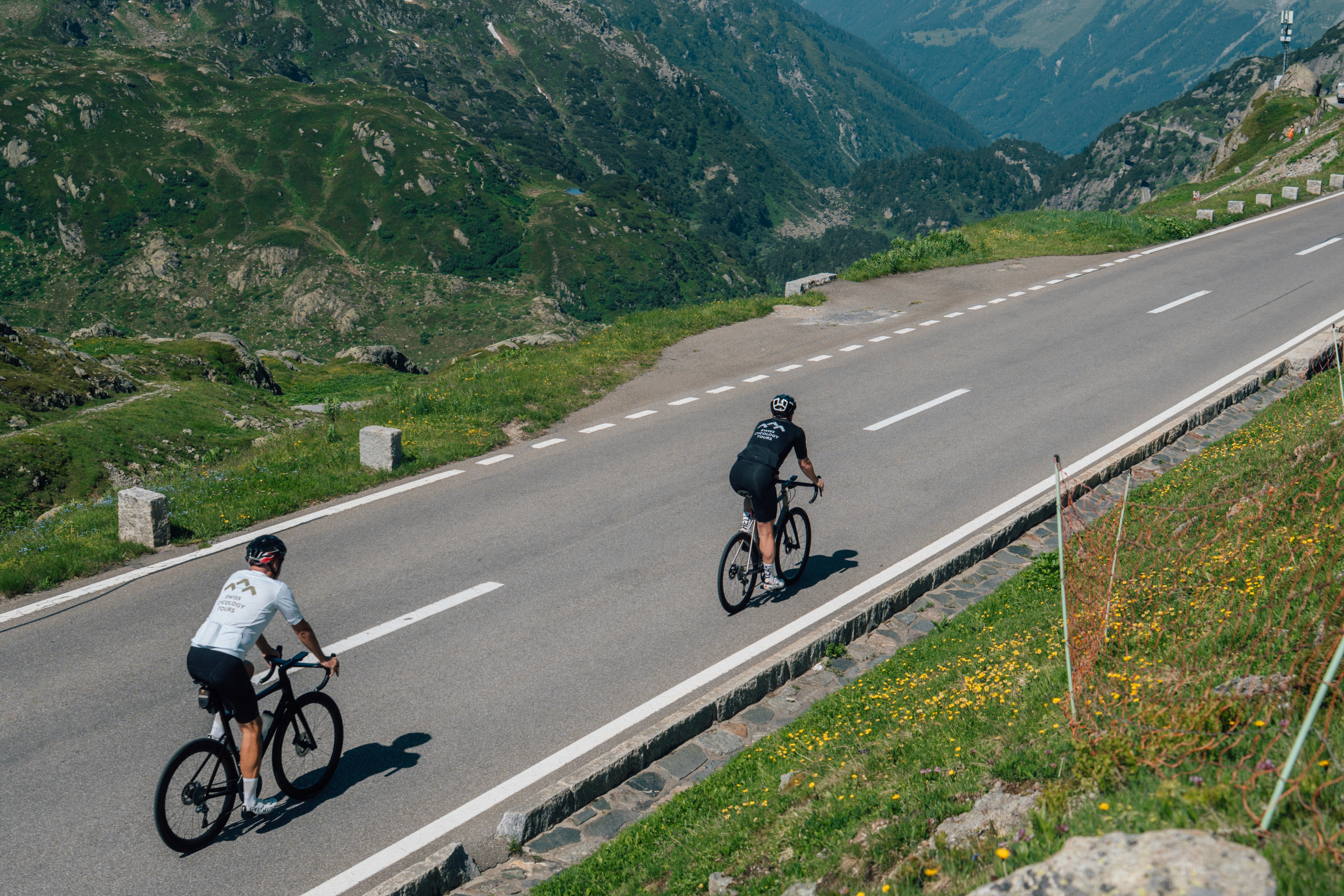
Cornering with a clean line
Your eyes lead, your bike follows. Look through the corner to your exit point, not down at the apex, and pick a line that starts wide, follows the inside of the bend, and drifts back out wide again. The classic racing line, and for good reason: it's the smoothest, safest way through the corner.
Lean the bike, not just yourself, into the turn. Weight your outside pedal (down position) and press gently on the inside bar rather than muscling the bike around. Riders who turn the handlebars sharply instead of leaning tend to run wide or need a mid-corner correction (flow beats force every time).
If you want to see this technique properly broken down, GCN's "How to descend faster" is a great watch, and a good complement to reading about it.
Don't stop pedalling
It feels natural to freewheel on the way down, but keeping a light pedal stroke going has real benefits. It keeps your legs active and ready to make small adjustments, keeps you mentally switched on rather than coasting passively, and means you're already up to speed if the road flattens out or you need to accelerate out of a corner.
The fastest way to actually improve: ride it with people who know the roads
Reading about descending technique will only take you so far and the biggest jumps in confidence come from riding real Alpine descents alongside people who know them well. That's exactly what a Swiss Cycology Tours trip is built around: daily riding tailored to your level, with guidance you can put into practice on the same descent, the same day.
Enjoy the way down
Descending well isn't about bravado — it's about being relaxed, being smooth, and trusting the technique. Get your position, braking and cornering right, and the descent stops being the part of the ride you're just trying to survive.