
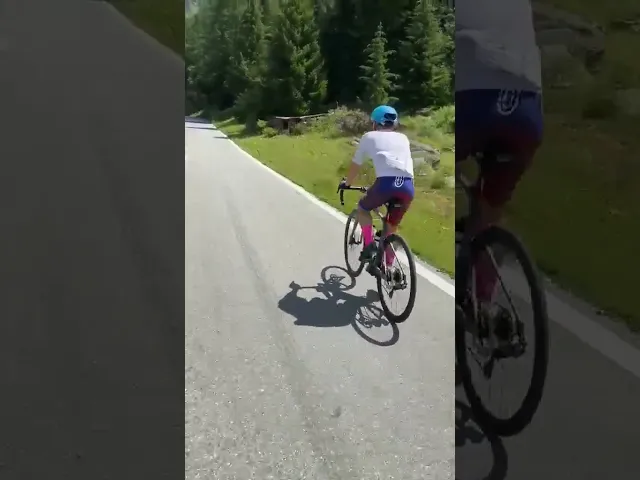
67kg/67%
The question we get asked the most when discussing our e-bike range is “how long does the battery last?” It’s not a straightforward answer and is a combination of factors, including the weight of the rider, how far they intend to ride, the gradient of any climbs, the cadence, and what power setting is being used.
We recently decided to put some of this theory to the test by organising an e-bike ride from the BMC Alpine Showroom & Test Centre in Andermatt to the top of the Furka Pass. At 12 kilometres long, with an elevation of nearly 900 metres it was a solid challenge.
The bike we chose was a 2026 BMC Roadmachine 01 AMP TWO, size 54. It can generate up to 360 watts an hour, and without pedals weighs 13.3kg. Our test rider, Mike from England, weighed 67kg and is an experienced cyclist. He set off from the showroom using the lowest assist mode (there are three; low, medium, and high).
“A bike like this changes what’s possible. The mountains don’t have to be just for the really strong riders and they’re pretty much open to anyone.” said Mike.
He arrived at the top under an hour later with 67% of his battery remaining. Not 67% used…..67% left. This may surprise a lot of people who assume e-bikes chew through their batteries on long climbs. The reality is that the TQ motor in the Roadmachine AMP is a remarkably efficient system, designed to supplement your effort rather than replace it.
“It’s hard to explain until you’ve tried it. You’re still working, but the bits where you’d normally really struggle aren’t there. It felt like I was climbing on a really good day.” commented Mike.
We have the BMC Roadmachine 01 AMP and BMC Teammachine 01 AMP to test, hire and buy from our showroom in Andermatt.
A few practical tips for getting the most from your e-road bike battery
Start on the lowest assist setting and only move up when you genuinely need to
Keep your cadence smooth and consistent rather than grinding in a big gear; the motor works most efficiently when you are pedaling steadily
On descents, switch to zero assist and let the bike roll freely — there is no need to use the motor on the way down.